Vietnam continues to attract international companies seeking suppliers, distributors, commercial partners, and investment opportunities in Southeast Asia. Its expanding industrial base, growing consumer market, and participation in global trade networks create opportunities for businesses looking to establish or strengthen their presence in the region.
However, finding the right local partner is not always straightforward. Foreign companies may encounter language barriers, limited access to reliable market information, and significant differences between businesses in terms of capabilities, resources, and management practices. Online directories can identify potential partners, but they rarely provide enough information to support a final decision.
Structured business matchmaking can make this process more efficient. By combining clear partner criteria, institutional networks, direct meetings, and independent due diligence, foreign companies can identify relevant manufacturers, distributors, and strategic partners while reducing avoidable risks. This guide explains how businesses can approach B2B matchmaking in Vietnam and turn initial introductions into practical commercial relationships.
Vietnam’s Business Environment in 2026
According to Vietnam’s Foreign Investment Agency, total registered foreign direct investment (FDI) reached US$34.65 billion in the first half of 2026, while disbursed FDI was estimated at US$13.03 billion. Manufacturing and processing accounted for 53.3% of total registered FDI during the period, highlighting Vietnam’s continued role as a manufacturing and investment destination.
Beyond manufacturing, Vietnam offers opportunities for companies seeking local distribution networks, commercial representation, and partnerships to support market entry. Its growing business ecosystem connects domestic enterprises, foreign-invested companies, distributors, service providers, and industry associations across multiple sectors.
These opportunities also come with challenges. Finding a company with relevant products or market access does not necessarily mean it is the right partner. A distributor may have an established network but lack the resources to develop a new product category. A manufacturer may have modern equipment but limited production capacity available for new orders. A potential strategic partner may share similar business interests but have different expectations regarding investment, responsibilities, or long-term growth.
Foreign companies therefore need to look beyond company profiles and initial introductions. They must determine whether a potential partner has the capabilities, resources, commercial objectives, and operational standards required for the proposed collaboration.
Business matchmaking can support this process by helping companies identify relevant candidates before detailed negotiations begin. However, it should be treated as a partner identification and screening mechanism rather than a guarantee of commercial success.
Defining the Right Partner Profile
The first step in any B2B matchmaking process is to define the type of partner required. A company looking for a contract manufacturer has different priorities from a brand seeking a distributor or an investor exploring a joint venture.
For manufacturing and sourcing projects, original equipment manufacturers (OEMs) may be suitable for buyers with established product specifications and technical requirements. Original design manufacturers (ODMs) may be more appropriate when buyers want to leverage existing product designs, development capabilities, or tooling systems.
Companies planning to sell products in Vietnam may need a distributor with established sales channels, import experience, warehousing capacity, and a local sales team. Businesses entering the market for the first time may also seek commercial representatives or local partners who understand customer expectations, regulations, and industry practices.
Strategic partnerships serve different objectives. Companies may look for technology partners, joint venture partners, or businesses with complementary products, expertise, and resources. In these cases, alignment on commercial objectives, investment commitments, and responsibilities can be as important as technical or operational capabilities.
Once the required partner category is clear, the company should define practical evaluation criteria. These may include production capacity, market coverage, customer relationships, financial stability, technical expertise, certifications, regulatory experience, and communication capabilities. The relative importance of each criterion will depend on the intended collaboration.
For manufacturing projects, available production capacity deserves particular attention. Installed capacity only shows what a factory could theoretically produce. Buyers also need to determine how much capacity is currently available, which customers are already using the production lines, and whether the supplier relies on subcontractors during peak periods.
For distribution and commercial partnerships, companies should examine sales performance, geographic coverage, existing customer relationships, and the resources available to support market development. For strategic collaborations, they should assess complementary capabilities, decision-making processes, resource commitments, and expectations for the partnership.
Compliance requirements should reflect the partner’s industry and target market. Depending on the project, due diligence may cover environmental standards, workplace safety, labor practices, product certifications, traceability, or other regulatory obligations.
The purpose of the partner profile is not to create an unrealistic list of requirements. It is to identify the capabilities that are essential to the project and separate them from features that are only desirable.
Choosing Business Matchmaking Channels in Vietnam
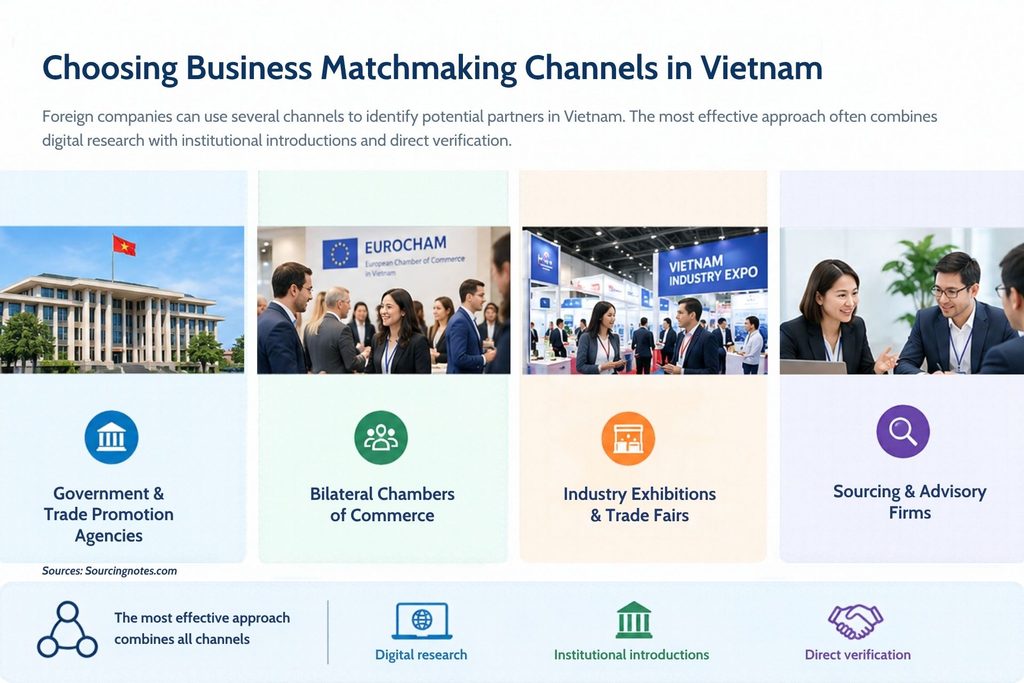
Foreign companies can use several channels to identify potential partners in Vietnam. The most effective approach often combines digital research with institutional introductions and direct verification.
The Vietnam Trade Promotion Agency, operating under the Ministry of Industry and Trade, is one established channel for trade promotion and international business connections. Government-supported missions and B2B programs may help foreign companies access exporters, manufacturers, and industry representatives. Institutional involvement can improve initial credibility and provide useful market context, but companies should not interpret participation as a full endorsement of every business introduced.
Bilateral chambers of commerce such as EuroCham, AmCham, KorCham, and BritCham also provide networking opportunities. Their events, directories, and sector committees can connect new market entrants with local companies, foreign-invested enterprises, and professional service providers. Chamber networks may be particularly useful for companies seeking partners familiar with international business practices.
Industry exhibitions are another practical channel. Trade fairs allow businesses to explore products, meet potential suppliers and distributors, and discuss opportunities directly with company representatives. They can be useful in sectors such as electronics, machinery, textiles, food processing, and consumer products. However, exhibiting at a trade fair or participating in a business delegation does not automatically establish a company’s suitability as a commercial partner.
Specialized sourcing and advisory firms can provide a more tailored approach. Depending on their expertise, local consultants may help define partner criteria, create a shortlist, contact relevant companies, arrange meetings, and support preliminary verification. This can save time when foreign companies have specific requirements or limited local resources. Companies should still understand how potential partners are selected and whether commercial relationships could affect the objectivity of recommendations.
From Initial Match to a Sustainable Partnership
An introductory meeting is only the beginning of the partner-selection process. Once a potential match has been identified, the next step is to determine whether both parties have the capabilities and shared objectives needed to make the collaboration work.
For manufacturing and sourcing partnerships, companies should assess technical capabilities, production capacity, quality management, delivery performance, and compliance with product specifications. Factory visits and audits can help buyers examine machinery, production flow, raw-material management, quality control, traceability, and workplace conditions. They can also help verify whether key processes are performed internally or subcontracted.
For distribution and commercial partnerships, companies should evaluate market coverage, customer relationships, sales capabilities, logistics resources, and relevant import or regulatory experience. Discussions should clarify target customers, territories, marketing responsibilities, pricing arrangements, and expectations for sales development. Where appropriate, references and evidence of previous commercial performance can support the assessment.
For strategic partnerships and joint ventures, due diligence should focus on complementary capabilities, financial resources, ownership structures, decision-making authority, and the objectives of each party. Both sides should clarify their expected contributions, responsibilities, investment commitments, and approach to sharing risks and returns.
Legal due diligence is important across all three categories. Companies should verify business registration, ownership, relevant licenses, and the authority of the person signing the agreement. Contracts should reflect the nature of the collaboration, covering relevant responsibilities, commercial terms, performance expectations, confidentiality, and dispute resolution mechanisms.
Intellectual property protection should also be addressed before sensitive information is shared. Depending on the project, this may involve confidentiality agreements and appropriate protection for trademarks, patents, industrial designs, technical drawings, or proprietary business information.
Rather than committing immediately to a large order, an exclusive distribution agreement, or a long-term partnership, companies may consider a pilot project or an initial trial period. A limited production run, a test distribution arrangement, or a defined collaboration project allows both parties to assess communication, execution, performance, and problem-solving before expanding the relationship.
Cultural alignment also influences long-term performance. Vietnamese business relationships often develop through consistent communication and practical cooperation. Trust should not replace formal agreements, but it can support more effective discussions and problem-solving when challenges arise.
Foreign companies should maintain regular contact, communicate expectations clearly, and avoid changing requirements without explanation. Local partners are more likely to invest in a relationship when they understand the commercial objectives and see a realistic opportunity for long-term cooperation.
Conclusion
Business matchmaking in Vietnam can help foreign companies identify manufacturers, distributors, and strategic partners more efficiently. Its value lies in creating relevant introductions and providing a structured starting point for market research, commercial discussions, and partnership development.
However, successful matchmaking requires preparation. A clear partner profile, realistic commercial objectives, and appropriate screening criteria are essential before meetings begin. Institutional networks, chambers of commerce, exhibitions, and specialized advisory firms can support partner identification, but none should replace independent verification.
The next steps will depend on the type of collaboration. Factory assessments may be necessary for manufacturing projects, while distributor evaluations and market validation are more relevant for commercial partnerships. Strategic collaborations may require deeper financial, legal, and organizational due diligence.
When relevant introductions are combined with careful assessment, clear agreements, and consistent relationship management, business matchmaking can become a practical part of a wider market-entry and business development strategy in Vietnam.